
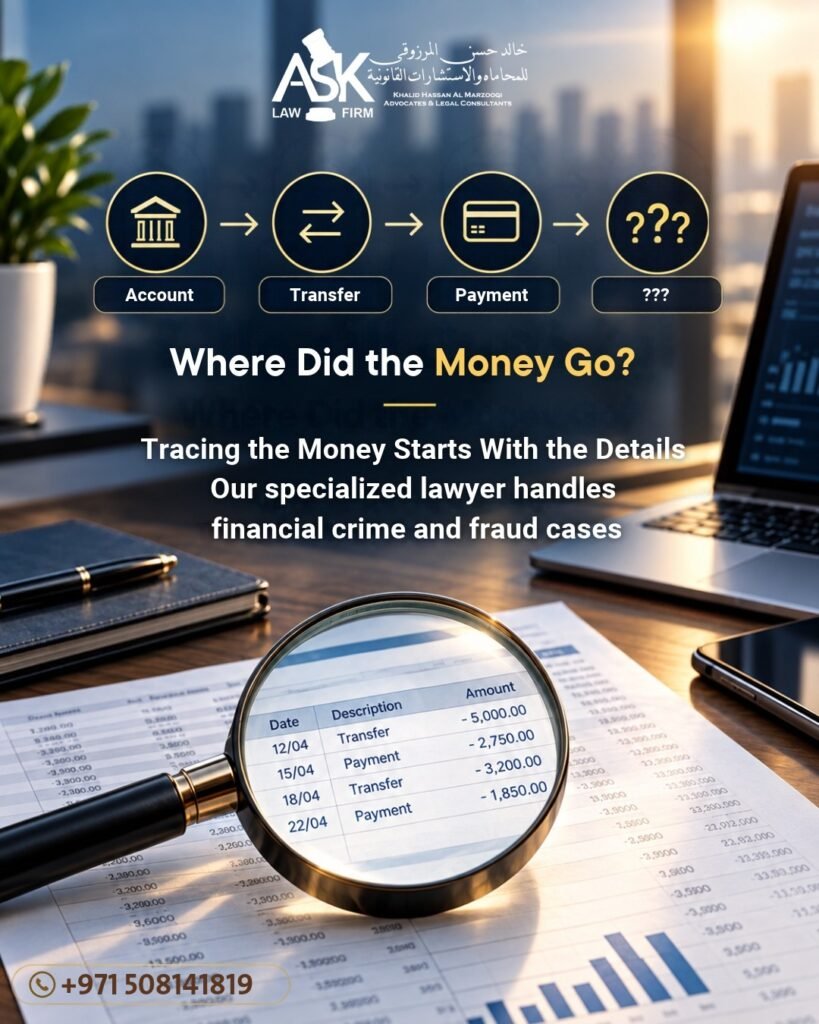
Where Did the Money Go? Tracing Financial Transactions and Pursuing Fraud Claims in the UAE
By Khaled Hassan Al Marzouqi Advocates & Legal Consultants – ASK LAW FIRM
When an individual or business discovers missing funds, an unexpected bank transfer, or payments that cannot be reconciled with its records, one question immediately arises: Where did the money go, who received it, and what legal steps may help trace or recover it?
The answer often begins with the details: bank statements, transaction references, payment instructions, invoices, contracts, emails, messages, and accounting records. Examined together, these materials may reveal inconsistencies, unauthorised transactions, suspicious changes to beneficiary details, or circumstances that require further investigation.
Digital banking, online payments, electronic communications, and cross-border transactions have made financial fraud cases increasingly complex. Funds may move through several accounts or payment services, while the original instruction may appear to be a legitimate business request. This is why preserving evidence and reporting suspected fraud promptly can be important.
This guide explains how individuals and companies in the United Arab Emirates can approach suspected financial fraud, organise transaction evidence, understand potential reporting and legal options, and assess the role of a lawyer experienced in financial crime matters. Each case must be evaluated according to its specific facts, evidence, applicable legislation, and procedural requirements.
1. What Is Financial Fraud?
Financial fraud generally involves deception or dishonest conduct intended to obtain money or a financial benefit, or to cause another person financial loss. However, the legal classification of a particular incident depends on the relevant law and the evidence. A financial loss, unpaid invoice, or contractual disagreement does not automatically establish a criminal offence.
Suspected financial fraud may arise in situations such as:
- A bank transfer made after the recipient was given misleading information.
- Impersonation of a bank employee, supplier, company officer, or public official.
- Phishing messages designed to obtain banking credentials or verification codes.
- Unauthorised changes to a supplier’s bank account details.
- False invoices or documents used to request payment.
- Unauthorised transactions from an individual or company’s account.
- Misrepresentation about the identity or purpose of a payment beneficiary.
- Electronic communications used to induce a person to transfer money.
Some incidents may involve cybercrime, identity misuse, forgery, or other offences, depending on the conduct and applicable legal provisions. Other matters may be civil or commercial disputes that require a claim for payment, repayment, or compensation.
A careful legal assessment should distinguish what the records actually establish from what remains an allegation requiring investigation.
2. Where Did the Money Go? Start With the Transaction Trail
Tracing funds is not simply a matter of guessing where money might be held. It involves reconstructing the available transaction history and linking each payment to its source, destination, purpose, and supporting records.
The initial review should ask:
- Which account or payment service sent the funds?
- What were the transaction date, time, amount, and currency?
- What transaction reference or payment identifier was issued?
- What beneficiary details appear in the available records?
- Was the payment supported by a contract, invoice, or approved instruction?
- Were beneficiary details changed shortly before payment?
- Does the amount match the underlying business transaction?
- Are there other transfers connected to the same event?
- Has the bank or payment provider been notified?
- Are there emails, messages, or call records explaining how the payment was authorised?
These questions help establish a factual timeline and identify missing information. They may also help distinguish an administrative error, a commercial disagreement, an unauthorised payment, and suspected criminal conduct.
Importantly, an account holder may not be entitled to access information about every subsequent account through which the funds pass. Further banking information may require formal requests or lawful procedures involving the competent authorities.
3. How Can Financial Transfers Be Traced?
The appropriate process depends on the transaction and the information available. The following steps can help organise the evidence and guide further action.
Step One: Obtain Official Bank Records
Request the relevant statements and transaction confirmations through the bank’s official channels. Preserve records showing the amount, date, beneficiary information available to you, and transaction reference.
Avoid relying solely on cropped screenshots if official records can be obtained. Keep a complete copy of the statement and separately identify the transactions that require investigation.
Step Two: Build a Chronological Timeline
Create a timeline covering the events before and after the suspected fraud. For example, record when a suspicious email arrived, when supplier bank details changed, when an invoice was issued, when the transfer was executed, and when the discrepancy was discovered.
A useful transaction log may include:
- Date and time.
- Amount and currency.
- Sending account or paying entity.
- Available beneficiary information.
- Transaction reference.
- Related invoice, contract, or payment instruction.
- Reason the transaction appears suspicious.
- Steps taken after discovery.
A well-organised timeline can help a lawyer, accountant, forensic specialist, or competent authority understand the sequence without having to reconstruct it from scattered documents.
Step Three: Compare Transfers With Contracts and Invoices
A document may appear genuine while containing altered payment details. A fraudster may also send an urgent request to replace a supplier’s usual bank account or use an email address that closely resembles the legitimate address.
Compare the questioned documents with previous approved records. Independently verify any change in payment details using a trusted contact method already on file. Do not rely on replying to the suspicious message or calling a number supplied in that message.
Step Four: Identify the Financial Institutions Involved
Record the bank, payment platform, money transfer provider, or other financial service associated with each transaction. Contact the relevant provider promptly and ask what reporting, review, recall, or protective procedures may be available.
The provider’s ability to intervene depends on the circumstances, applicable rules, transaction status, and its procedures. A report does not guarantee that funds can be stopped or recovered.
Step Five: Consider Accounting or Technical Analysis
Complex cases may involve several transfers, multiple currencies, related companies, or extensive electronic records. An accountant or appropriately qualified forensic specialist may assist in reconciling transactions, identifying discrepancies, and linking payments to the available supporting evidence.
Any report should clearly distinguish verified facts from assumptions and conclusions that require further confirmation.
4. What Evidence Can Support a Financial Fraud Complaint?
The usefulness of evidence depends on its reliability, relevance, and connection to the suspected conduct. Important categories may include the following.
Banking records: Account statements, transfer confirmations, payment receipts, transaction references, and correspondence with the financial institution.
Commercial records: Contracts, invoices, purchase orders, delivery records, supplier files, approved beneficiary details, and payment authorisations.
Electronic communications: Emails, text messages, messaging-platform conversations, notices of changed payment instructions, and communications that explain why a transfer was made.
Technical records: Relevant access logs, device information, system records, or other technical data, where lawfully available and obtained through authorised procedures.
Accounting records: Ledger entries, reconciliations, internal reports, approval records, and documents showing who requested, reviewed, or authorised a payment.
Reporting records: Complaint references, dates of communication with the bank, responses from relevant entities, and records of steps taken after the incident was discovered.
Preserve original records and avoid editing files that may be relevant. If electronic evidence must be extracted from a device or account, use lawful procedures and appropriately qualified assistance. Do not access another person’s account or obtain private banking information without authorisation.
5. What Should You Do Immediately After Discovering a Suspicious Transfer?
Time may matter in cases involving unauthorised transactions or electronic fraud. Acting promptly can help preserve available options, although no particular outcome is guaranteed.
- Contact the bank or payment provider immediately. Use its official contact details, report the transaction, obtain a complaint reference, and ask whether any permitted protective or transaction-review steps remain available.
- Secure affected accounts. If account compromise is suspected, change relevant passwords, secure the associated email account and phone, enable additional authentication where available, and ask the bank whether cards or access credentials should be blocked or replaced.
- Preserve the evidence. Save statements, transfer confirmations, emails, messages, and transaction references. Record when the incident was discovered and what steps were taken.
- Consider reporting suspected criminal conduct. Seek guidance on the appropriate official reporting channel based on the facts, location, and nature of the incident.
- Notify the relevant business team. If the incident concerns a company, protect internal records, review payment permissions, and identify any affected supplier or customer processes.
- Obtain legal advice. A legal review can help organise the facts, assess potential claims, and determine whether criminal, civil, or commercial procedures should be considered.
Avoid actions that may expose you to risk, destroy evidence, or alert a suspected offender in a way that could compromise the investigation. Do not publish unverified accusations online.
6. Can Transferred Money Be Recovered?
Recovery depends on the circumstances. Relevant factors may include how quickly the incident was reported, where the funds are held, the type of transaction, the information available about the recipient, and the legal procedures that can be pursued.
Depending on the facts, potential options may include:
- Asking the bank or payment provider to review the transaction.
- Requesting any available transfer-recall or protective procedure.
- Making a criminal complaint where the evidence indicates suspected criminal conduct.
- Considering a civil or commercial claim for repayment or compensation.
- Seeking accounting or technical analysis to establish the amount and nature of the loss.
- Exploring lawful interim measures or enforcement procedures where the legal requirements are satisfied.
A local transfer, an international transfer, a card transaction, and a payment made through an online platform may involve different processes. The possibility of recovery also depends on whether the funds remain with the initial recipient or have moved elsewhere.
Tracing a transaction, proving legal liability, and obtaining repayment are separate stages. Identifying a beneficiary does not by itself prove that the beneficiary committed fraud or guarantee that the money will be returned.
7. Financial Fraud and Cybercrime Under UAE Law
Some financial fraud incidents involve information technology, electronic communications, identity misuse, or unauthorised access to systems. Depending on the facts, such conduct may require assessment under the UAE’s legislation addressing cybercrime, together with other applicable criminal laws.
Federal Decree-Law No. 34 of 2021 on Combatting Rumours and Cybercrimes is one relevant legislative reference for certain offences involving information technology. The UAE’s Crimes and Penalties Law and criminal procedure legislation may also be relevant depending on the conduct and procedural stage.
The precise offence, legal elements, penalties, jurisdiction, and procedure must be verified against the legislation in force and the specific facts. Not every online payment dispute constitutes cybercrime, and a financial loss alone does not establish criminal liability.
The official UAE legislation platform provides access to federal legislation and updates. Legal practitioners should check the current text and amendments before relying on a particular provision in a complaint, submission, or court proceeding.
8. What if the Funds Passed Through Several Accounts or Left the UAE?
Cases become more complex when funds move through multiple accounts, payment services, companies, or overseas recipients. It is important not to assume that every person or entity receiving a subsequent transfer participated in the suspected fraud. Each party’s role must be assessed using reliable evidence and lawful procedures.
Depending on the circumstances, the investigation may require cooperation between financial institutions and competent authorities, including formal requests for information or international cooperation where available. The ability to take protective measures may depend on where the funds are located and which authority has the legal power to issue the relevant order.
Businesses and individuals should preserve the complete transaction trail and avoid making unsupported claims about the identity or intention of a recipient. A clear record of the original payment, subsequent known transactions, and relevant communications may assist the competent authorities in assessing the matter.
9. How Can Businesses Reduce Financial Fraud Risks?
Prevention is often more effective than trying to resolve a loss after funds have left an account. Businesses can consider practical controls such as:
- Requiring more than one approval for high-value or unusual transfers.
- Independently verifying supplier bank-account changes.
- Restricting access to financial systems according to job responsibilities.
- Using multi-factor authentication where available.
- Reconciling bank statements and accounting records regularly.
- Training employees to recognise phishing and impersonation attempts.
- Maintaining clear records of payment instructions and approvals.
- Establishing an incident-response plan that includes evidence preservation and prompt bank notification.
- Reviewing unusual transactions and changes to beneficiary information.
A bank-account change should not be accepted solely on the basis of an email, particularly where the message demands urgency, secrecy, or an exception to normal approval procedures.
10. How Can a Lawyer Assist With a Financial Fraud Matter?
Effective legal work begins with understanding the facts and identifying the available evidence before deciding which procedure may be appropriate. Depending on the scope of engagement and applicable law, a lawyer may assist with:
- Reviewing the circumstances and identifying potential legal issues.
- Organising bank statements, payment records, contracts, and communications.
- Preparing a chronology of the transactions and identifying discrepancies.
- Drafting a complaint or legal submission based on the available evidence.
- Assessing which requests may lawfully be made to the competent authorities.
- Considering whether accounting or technical expertise is needed.
- Evaluating potential repayment or compensation claims.
- Advising on related criminal, civil, or commercial procedures.
- Helping protect confidential financial information and relevant documents.
Legal representation cannot guarantee a particular decision or the recovery of the full amount. Outcomes depend on the evidence, the facts, applicable law, and decisions of the competent authorities. Nevertheless, a carefully organised file can help present the matter clearly and support an informed assessment of the available options.
11. Common Mistakes to Avoid
Common mistakes include delaying notification to the bank, deleting relevant messages, altering original records, relying only on incomplete screenshots, or assuming that the named beneficiary must be the person responsible for the alleged fraud.
Other risks include accessing someone else’s accounts without permission, obtaining private financial data unlawfully, publishing unverified allegations, or presenting assumptions as established facts. These actions may undermine the investigation or create additional legal exposure.
Preserve the available evidence, record what happened as accurately as possible, distinguish confirmed facts from matters requiring verification, and use official reporting channels.
12. Frequently Asked Questions About Financial Fraud and Tracing Funds in the UAE
How should I respond to a bank transfer I did not authorise?
Contact the bank through official channels immediately, report the transaction, obtain a complaint reference, secure affected accounts, and preserve the relevant statements and transaction details. Seek advice about reporting suspected criminal conduct where appropriate.
Can I find out which account received the money?
The available transaction records may identify an initial beneficiary, but obtaining information about other accounts or subsequent transfers is subject to applicable law, authorised procedures, and the powers of the relevant authorities.
Does filing a police report guarantee that my money will be returned?
No. A report allows the circumstances to be presented to the competent authority, but recovery depends on the facts, evidence, location of the funds, and applicable procedures and decisions.
Is every unpaid debt financial fraud?
No. An unpaid debt may be a civil or commercial dispute. Whether criminal fraud is involved depends on the conduct, the relevant legal elements, and the evidence—not simply on the fact that payment was not made.
What documents should I prepare before consulting a lawyer?
Useful documents may include bank statements, transfer confirmations, contracts, invoices, relevant messages, existing complaint references, and a short timeline. Never share passwords or verification codes as part of a legal consultation.
Can I claim compensation as well as report suspected fraud?
A repayment or compensation claim may be available depending on the facts and procedural rules. The appropriate route, jurisdiction, deadlines, and relationship between criminal and civil or commercial proceedings should be assessed individually.
What if the suspected fraud began with a fake email or message?
Preserve the original message and available details, avoid suspicious links, secure affected accounts, and contact the bank if the message led to a payment or disclosure of financial information. Consider reporting the incident through the appropriate official channel.
Can funds transferred outside the UAE be traced?
Tracing may be possible depending on available records, official channels, and cooperation between competent authorities. The timeframe, practical options, and prospect of recovery vary from case to case.
13. SEO Keywords and Hashtags
Primary keyword: Financial fraud lawyer in the UAE.
Supporting keywords: financial crime lawyer UAE, fraud lawyer UAE, trace bank transfers UAE, recover money after fraud UAE, unauthorised bank transfer UAE, financial fraud complaint UAE, cybercrime lawyer UAE, financial transaction tracing, fraud investigation UAE, money recovery legal advice, financial fraud lawyer Sharjah, fraud lawyer Dubai, corporate fraud prevention UAE, compensation claim for fraud.
English hashtags:
#FinancialFraud #FinancialCrimeLawyer #UAE法律 #UAE法律Advice #FraudInvestigation #TraceTheMoney #MoneyRecovery #CybercrimeUAE #UAE法律Firm #ASKLawFirm
Conclusion: Get Legal Guidance on Suspected Financial Fraud
When money disappears or unexplained transfers appear in an account, the transaction details can be the starting point for understanding what happened. Identifying the source of a payment, preserving the records, reporting promptly, and obtaining appropriate legal advice may help protect your rights and clarify the available options.
Khaled Hassan Al Marzouqi Advocates & Legal Consultants – ASK LAW FIRM provides legal services in the UAE, including the review of documents and facts and the assessment of legal options based on the circumstances of each matter.
Contact us for a legal enquiry:
📞 Phone: +971 508141819
📧 Email: info@asklegaluae.com
🌐 Website: https://asklegaluae.com
This article is for general legal information and is not a final legal opinion on any particular case. Liability, available claims, and procedural options require review of the relevant documents, facts, and legislation in force.