
Divorce for Harm in the UAE: Conditions, Grounds, Evidence, Procedure and Rights Under UAE Personal Status Law 2026
Divorce for harm in the UAE is an important legal mechanism available when the continuation of marital life becomes impossible because of harm caused by one spouse to the other.
Under the current UAE Personal Status Law, the right to seek judicial divorce for harm is not restricted to women. Both spouses may request divorce where the harm prevents the continuation of marital life in accordance with accepted standards of marital coexistence.
The current legal framework is primarily governed by Federal Decree-Law No. 41 of 2024 on the Issuance of the Personal Status Law, which came into force on 15 April 2025 and regulates marriage, divorce, custody, maintenance and other personal status matters.
This article is designed for publication on Legal Advice Middle East and provides an SEO-focused explanation of divorce for harm in the UAE, including legal requirements, evidence, arbitration, family guidance, financial rights and children’s rights.
What Is Divorce for Harm in the UAE?
Divorce for harm is a judicial process through which one spouse asks the competent court to terminate the marriage because the other spouse has caused harm that makes continued marital life impossible.
Article 71 of the UAE Personal Status Law provides that each spouse has the right to request divorce due to harm that prevents the continuation of marital life according to accepted standards, and the court may grant divorce where the harm is proven and reconciliation is impossible.
This means that a disagreement, argument or ordinary marital conflict does not automatically constitute legal harm.
The court must consider the circumstances of the case, the evidence submitted, the seriousness of the harm and whether reconciliation remains possible.
Can a Husband Also File for Divorce for Harm?
Yes.
A common misconception is that judicial divorce for harm is exclusively a right of the wife.
Article 71 uses language that grants the right to each spouse.
Therefore, a husband may also seek judicial divorce for harm if the legal requirements are satisfied and the alleged harm is established before the court.
The outcome of every case depends on its particular facts and evidence.
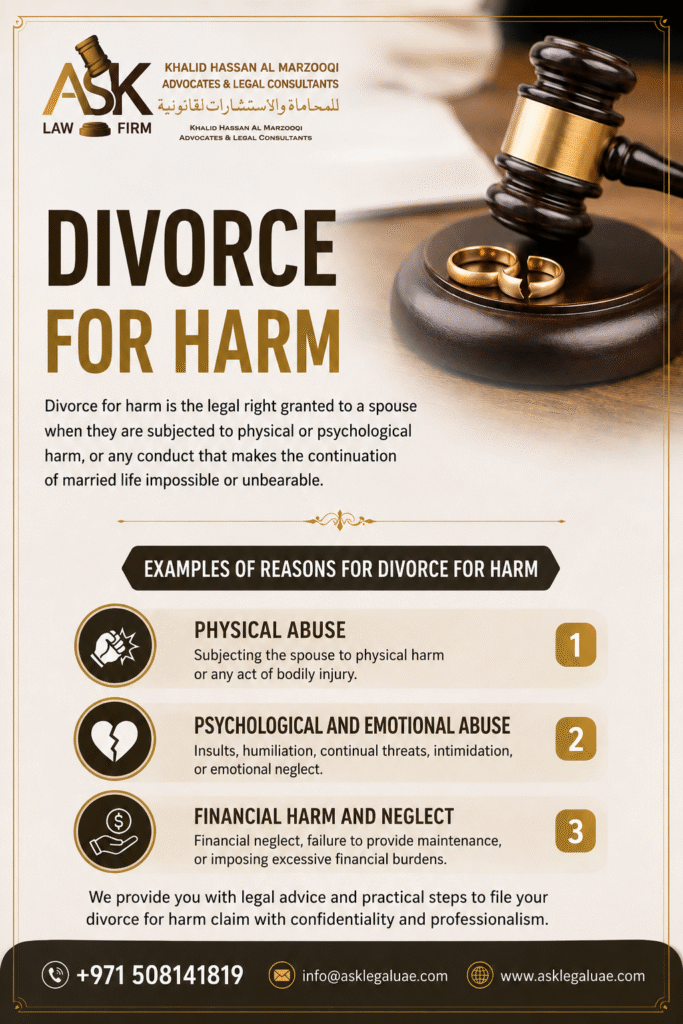
What Are Examples of Harm That May Support Divorce?
The law does not create a simple closed list of every possible form of marital harm.
The following are examples that may require legal assessment depending on the circumstances:
1. Physical Abuse
Physical violence, assault, hitting, injury or other forms of physical abuse may be relevant to a divorce-for-harm claim.
Depending on the circumstances, medical reports, police reports, criminal proceedings and other evidence may become important.
However, the existence of an allegation alone does not automatically guarantee a divorce judgment. The court must assess the evidence and determine whether the legal requirements are satisfied.
2. Psychological and Moral Abuse
Psychological and moral harm may also become relevant in a family-law dispute.
Examples may include:
- Repeated insults.
- Threats.
- Humiliation.
- Persistent verbal abuse.
- Deliberate emotional abuse.
- Conduct that seriously disrupts marital life.
The stronger approach is to identify specific incidents, dates, circumstances and supporting evidence rather than relying on general statements.
3. Financial Harm and Failure to Provide Maintenance
Financial disputes can also become relevant to marital breakdown.
The Personal Status Law separately regulates certain situations involving failure to provide maintenance. Article 77, for example, establishes specific rules concerning divorce for failure to provide maintenance to the wife.
Therefore, it is important to distinguish between a general divorce-for-harm claim and specific statutory grounds that have their own legal requirements.
Can Infidelity Be a Ground for Divorce?
Infidelity is one of the most sensitive issues in family disputes.
However, every case must be assessed individually.
The legal significance of alleged infidelity depends on:
- The facts.
- The evidence.
- The circumstances.
- The impact on marital life.
- The way the claim is presented to the court.
Unverified accusations should not be treated as established facts.
A careful legal assessment should be conducted before filing a claim.
What Evidence Can Be Used in a Divorce-for-Harm Case?
The appropriate evidence depends on the type of harm alleged.
Potential evidence may include:
- Medical reports.
- Police reports.
- Official records.
- Criminal judgments or related documents.
- Financial documents.
- Maintenance records.
- Correspondence.
- Electronic communications.
- Witness evidence where legally admissible.
- Other documents relevant to the dispute.
The existence of a document does not automatically mean that it will be accepted as decisive evidence.
The court evaluates evidence according to the applicable legal rules.
Can WhatsApp Messages Be Used as Evidence?
Digital communications can be relevant in modern family disputes.
However, a screenshot alone should not automatically be assumed to be conclusive evidence.
Important considerations may include:
- The source of the communication.
- Authenticity.
- Attribution to the sender.
- Whether the conversation has been edited or selectively presented.
- How the evidence was obtained.
- Applicable rules governing electronic evidence.
For this reason, preserving original electronic evidence can be important.
What Happens If the Harm Is Not Proven?
This is one of the most important issues under the current law.
Article 72 provides that if the harm is not proven, the court shall dismiss the case.
If discord continues, the injured spouse may, subject to the statutory requirements, file a new case after the judgment becomes final or six months from the issuance of the first-instance judgment, whichever is later, unless new harm or new circumstances arise as recognized by the court.
This makes proper preparation of the initial claim particularly important.
What Is the Role of Arbitrators?
Where reconciliation is not possible under the circumstances specified by the law, arbitrators may become involved.
Article 72 provides for each spouse to choose an arbitrator from their family within the period specified by the court. If this does not occur, the court may appoint arbitrators according to the statutory framework.
The arbitration period may not exceed 60 days from the date of appointment.
The purpose is not simply to prolong the case. The arbitrators are expected to investigate the reasons for the marital discord and attempt reconciliation.
What Do Arbitrators Do?
Article 73 requires arbitrators to listen to the spouses, investigate the causes of discord and make efforts to reconcile them.
Importantly, the refusal of either spouse to cooperate with the arbitrators does not prevent them from continuing their work.
If reconciliation fails, Article 74 regulates the arbitrators’ report and their position regarding separation, including whether separation should be with or without compensation.
The court ultimately evaluates the relevant factors and determines the legal consequences.
Does Family Guidance Apply to Divorce Cases?
The UAE Personal Status Law provides for family guidance mechanisms while also recognizing exceptions depending on the nature of the case.
The supervising judge may refer parties to the Family Guidance Department where an amicable settlement appears feasible. Certain matters are exempt from referral, including urgent matters and cases in which reconciliation is not foreseeable, subject to the statutory framework.
Accordingly, the procedure should be assessed according to the specific case and competent judicial authority.
Divorce for Harm vs. Khula
Divorce for harm and Khula are different legal mechanisms.
In a divorce-for-harm case, the central issue is the alleged harm, whether it is legally relevant, whether it has been proven and whether reconciliation is possible.
Khula operates under a different legal framework and may have different consequences.
The appropriate legal route should therefore be selected only after considering the facts, evidence, children, financial rights and potential consequences.
Does Divorce for Harm Affect the Wife’s Financial Rights?
The answer depends on the circumstances and the legal basis on which the marriage is terminated.
Potential issues may include:
- Dowry.
- Maintenance.
- Waiting-period maintenance.
- Post-divorce financial rights where applicable.
- Child maintenance.
- Housing.
- Custody-related expenses.
- Other financial claims.
A divorce judgment should therefore not be viewed in isolation from the financial and family consequences that may follow.
What Happens to Children After Divorce?
Divorce does not terminate the legal rights of children.
Issues such as:
- Custody.
- Child maintenance.
- Visitation.
- Housing.
- Education.
- Medical expenses.
- Travel and related matters.
may require separate legal consideration.
A comprehensive family-law strategy should therefore address both the termination of the marriage and the protection of children’s rights.
Common Mistakes in Divorce-for-Harm Cases
Exaggerating allegations
Unnecessary exaggeration can undermine credibility.
Filing without evidence
A legal claim should be supported by evidence wherever possible.
Ignoring digital evidence
Relevant electronic communications may need to be preserved properly.
Publishing accusations online
Publicly publishing allegations against a spouse may create additional legal risks.
Sending emotional messages
Threats, insults or aggressive communications can potentially create additional legal complications.
How Should a Divorce-for-Harm Case Be Prepared?
A strong case begins with a structured review of the facts.
The process may include:
- Identifying the main incidents.
- Creating a chronological timeline.
- Categorizing the alleged harm.
- Collecting available evidence.
- Assessing the evidential strength.
- Identifying the appropriate legal claim.
- Reviewing financial rights.
- Reviewing children’s rights.
- Determining jurisdiction and procedure.
- Preparing the statement of claim and supporting documents.
This approach allows the legal strategy to be based on facts and evidence rather than emotion.
Why Legal Advice Matters Before Filing?
A legal consultation can help answer critical questions:
- Is the conduct legally capable of constituting harm?
- What evidence is available?
- Is the evidence sufficient?
- Are electronic communications involved?
- Are there related criminal proceedings?
- Are children involved?
- What financial claims may arise?
- What court has jurisdiction?
- Is family guidance involved?
- Could arbitration be required?
- What should happen if the claim is rejected?
The objective should not simply be to “file a divorce case.”
The objective should be to choose the most appropriate legal route based on the facts, evidence and desired legal outcome.
Frequently Asked Questions — FAQ
Can a wife file for divorce for harm in the UAE?
Yes. Article 71 grants both spouses the right to request divorce for harm when the harm prevents continued marital life and the legal requirements are established.
What are common grounds for divorce for harm?
Depending on the facts, examples may include physical abuse, serious psychological or moral abuse, threats, repeated humiliation and certain forms of financial harm.
Is physical abuse required?
No. The legal concept of harm is not limited to physical injury. The circumstances and evidence of each case must be assessed.
Can WhatsApp messages be evidence?
They may be relevant, depending on authenticity, attribution, integrity, method of obtaining them and applicable evidence rules.
What happens if harm cannot be proven?
The court may dismiss the case. Article 72 also provides a framework for a subsequent claim in certain circumstances.
Can a husband file for divorce for harm?
Yes. The law grants the right to each spouse.
Does divorce automatically affect custody?
Not necessarily. Custody is governed by separate legal provisions and the circumstances concerning the children.
How long does a divorce-for-harm case take?
There is no single fixed duration for every case. The timeline depends on the facts, evidence, hearings, arbitration and possible appeals.
UAE divorce lawyer
UAE divorce lawyer
divorce for harm UAE, divorce for harm in UAE, UAE divorce lawyer, divorce lawyer UAE, family lawyer UAE, UAE family law, judicial divorce UAE, divorce due to harm UAE, personal status law UAE, UAE Personal Status Law 2024, UAE divorce 2026, divorce proceedings UAE, family court UAE.
family lawyer UAE
how to file divorce for harm in UAE, grounds for divorce for harm UAE, evidence for divorce for harm UAE, WhatsApp evidence in UAE divorce case, wife’s rights after divorce UAE, child custody after divorce UAE, maintenance after divorce UAE, arbitrators in UAE divorce cases, Article 71 UAE Personal Status Law.
If you are experiencing marital harm or considering filing a divorce-for-harm case in the UAE, a careful assessment of the facts, evidence and available legal options should be undertaken before commencing proceedings.
Khaled Hassan Al Marzooqi Advocates & Legal Consultants provides legal consultation and representation in UAE family-law matters, including divorce, judicial divorce, custody, maintenance and personal-status disputes.
📞 Phone: +971 508141819
📧 Email: info@asklegaluae.com
🌐 Website: asklegaluae.com