Divorce for Harm in the UAE: Grounds, Legal Requirements, Procedures and Spouses’ Rights
Introduction
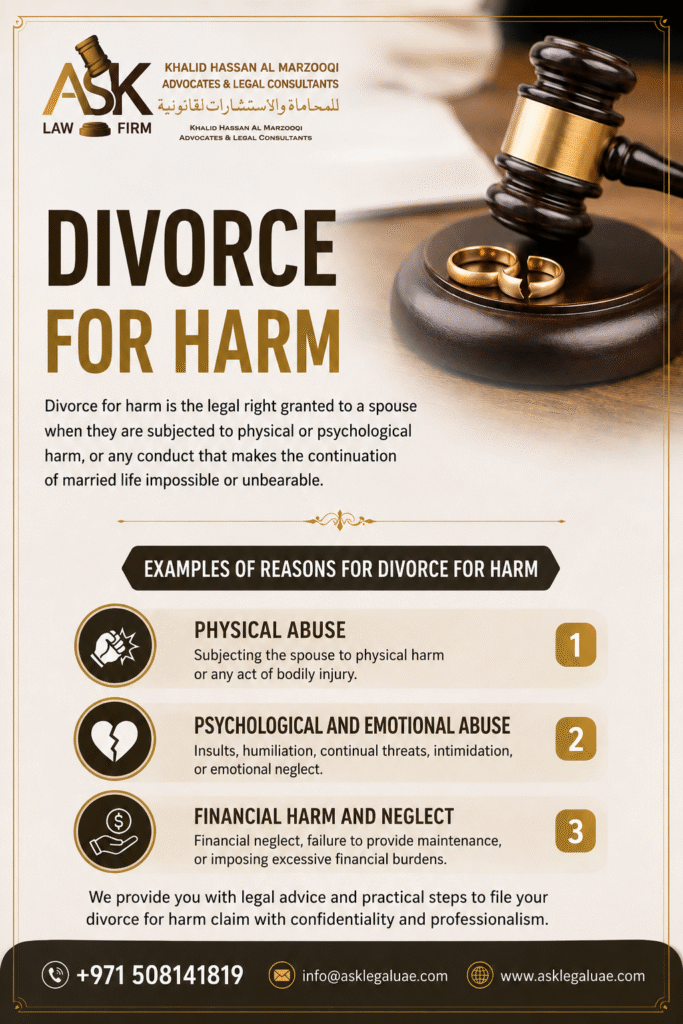
Marital disputes can sometimes develop into circumstances in which continuing married life becomes difficult or impossible. A spouse may experience physical abuse, repeated insults, threats, serious mistreatment, or other conduct that causes harm and undermines the stability of the family relationship.
In such circumstances, UAE law provides legal routes through which a spouse may seek the dissolution of the marriage. For marriages governed by the applicable Sharia-based Personal Status Law, one of these routes is judicial divorce on the grounds of harm.
Divorce for harm is not simply a request to end a marriage because the spouses disagree. It is a legal claim that must be assessed in light of the applicable legislation, the facts of the case, the evidence submitted, and the possibility of reconciliation.
The current federal legislation governing relevant Muslim personal status matters is Federal Decree-Law No. 41 of 2024 on the Issuance of the Personal Status Law, which came into force on 15 April 2025. Article 71 addresses divorce due to harm that makes continued marital life incompatible with customary standards of proper cohabitation. The court may grant divorce where the harm is established and reconciliation is not possible. UAE Legislation+1
This guide explains the legal meaning of divorce for harm in the UAE, potential grounds, evidence, court procedures, financial rights, child custody considerations, and the importance of obtaining legal advice before filing a claim.
1. What Is Divorce for Harm in the UAE?
Divorce for harm is a judicial claim through which either spouse seeks the termination of the marriage on the basis that harmful conduct has made continued marital life untenable under the applicable legal standard.
The harm may take different forms depending on the circumstances. It is not necessarily limited to physical violence. Repeated humiliation, threats, serious mistreatment, or other conduct may be relevant if the facts meet the legal requirements.
Article 71 of Federal Decree-Law No. 41 of 2024 recognises the right of either spouse to seek divorce due to harm that prevents the continuation of marital life in a proper manner. The court considers whether the alleged harm has been established and whether reconciliation is possible. UAE Legislation
Accordingly, the right to seek divorce for harm is not restricted to wives. Either spouse may bring a claim where the applicable legal conditions are satisfied.
2. Which UAE Law Applies?
Before filing a divorce claim, it is important to identify the law governing the marriage.
For Muslim couples, and certain marriages involving a Muslim husband and a non-Muslim wife, the UAE Government identifies Federal Decree-Law No. 41 of 2024 as the applicable Personal Status Law. u.ae
For non-Muslim couples, Federal Decree-Law No. 41 of 2022 on Civil Personal Status may apply, subject to its scope and applicable rules. Under the civil framework, either spouse may request divorce by expressing the intention to end the marital relationship without having to establish harm or assign fault to the other spouse. المنصة الرسمية لحكومة الإمارات العربية المتحدة+1
The applicable legal framework can therefore affect the grounds for divorce, the procedural route, financial consequences, and child custody arrangements. A legal assessment should be completed before preparing the claim.
3. What Circumstances May Support a Divorce-for-Harm Claim?
The court assesses each case based on its particular facts. The following circumstances may be relevant, depending on their seriousness, context, and supporting evidence.
Physical violence: Assault, physical abuse, or conduct resulting in injury may be relevant to a claim. Medical reports, official complaints, and other admissible evidence may help establish what occurred.
Repeated verbal abuse and humiliation: Persistent insults, degrading language, intimidation, or threats may be considered where their nature and impact are sufficiently serious.
Threats and intimidation: Repeated threats or conduct that creates a genuine sense of fear may be relevant, particularly when supported by lawful evidence.
Abandonment or serious marital neglect: Extended abandonment or conduct involving a serious failure to maintain marital responsibilities may be relevant depending on the facts and applicable law.
Financial neglect: Failure to meet legally required financial obligations may give rise to separate maintenance claims and may also be relevant to the wider marital dispute.
Conduct that seriously undermines family life: Other deliberate or repeated conduct may be considered where it causes established harm and makes continued marital life unreasonable.
Not every disagreement or argument constitutes legally recognised harm. The court evaluates the facts rather than relying solely on the labels used by either spouse.
4. Must Harm Be Proven?
For a claim under Article 71 of Federal Decree-Law No. 41 of 2024, the applicant must establish the harm relied upon and the legal requirement concerning the impossibility of reconciliation.
A general statement that the marriage has become unhappy may not, by itself, establish the legal basis for divorce for harm. The applicant should explain the relevant incidents, their timing, their seriousness, and their effect on marital life.
Evidence should be relevant, lawfully obtained, and presented in accordance with the applicable procedural rules. The court assesses the evidence as a whole and determines whether it is sufficient.
5. What Evidence May Be Used?
The appropriate evidence depends on the alleged conduct. Potentially relevant materials may include:
- Medical reports relating to injuries or health consequences.
- Police reports and official records.
- Relevant court judgments or official decisions.
- Lawfully obtained messages and electronic correspondence.
- Witness testimony, where admissible under the applicable rules.
- Financial documents where the dispute involves financial neglect.
- Other documents or circumstances that help establish the sequence of events.
A document does not automatically prove the entire claim. Its relevance, authenticity, context, and connection to the alleged harm may all be considered.
Parties should avoid accessing private accounts, recording communications, or obtaining personal information through unlawful methods. Evidence should be collected and submitted in a legally compliant manner.
6. Can Psychological or Emotional Abuse Be Relevant?
Psychological or emotional mistreatment may be relevant where the conduct is sufficiently serious and can be established through appropriate evidence.
Examples may include persistent intimidation, serious humiliation, repeated threats, or other conduct that has a substantial effect on the marital relationship.
1- A party should describe the specific incidents rather than relying only on broad descriptions. 2- A chronology of events, relevant correspondence, official reports, or professional documentation may assist the court in understanding the circumstances.
3- A claim for divorce and a separate claim for compensation are not necessarily the same. Any compensation request requires its own legal basis and assessment.
7. What Are the Main Procedures?
The correct procedure depends on the applicable law, the competent court, and whether the case is subject to family guidance or an exception.
The UAE Government describes the general process for relevant divorce applications as beginning with registration through the Family Guidance Section, followed by a family guidance meeting and an attempt to reach an amicable settlement where that process applies. If no settlement is reached, the dispute may be referred to the competent court. The referral letter must be submitted to the court within one month from its issuance, according to the government guidance. u.ae
A practical preparation process may include:
- Legal assessment: Identify the applicable law, jurisdiction, and appropriate legal grounds.
- Evidence preparation: Collect the marriage certificate, identification documents, and evidence relevant to the alleged harm.
- Application registration: Submit the application through the competent authority and follow the applicable procedural route.
- Family guidance or settlement stage: Participate where required and consider whether a lawful settlement is possible.
- Court proceedings: File the claim and submit supporting documents and legal arguments.
- Hearings and submissions: Respond to the other party’s arguments and comply with the court’s directions.
- Judgment and follow-up: Review the judgment and take any legally available steps concerning its effect, enforcement, or appeal.
These stages are a general guide. They should not be treated as a guarantee that every divorce case will follow an identical process.
8. What Happens if the Harm Is Not Established?
If the court finds that the alleged harm has not been established, it may dismiss the divorce-for-harm claim.
However, the Personal Status Law also addresses continuing discord between spouses. The relevant provisions provide for further procedures involving arbitration in circumstances specified by law. The legislation addresses the appointment of arbitrators, their efforts to reconcile the spouses, and the preparation of a report where reconciliation cannot be achieved. LexMENA
The law also regulates when a new claim may be brought following a dismissal where discord continues, subject to the statutory conditions and exceptions.
This makes accurate preparation particularly important. A claim should identify the relevant events, provide supporting evidence, and clearly explain the legal relief requested.
9. What Financial Rights May Arise After Divorce?
The financial consequences of divorce depend on the applicable law, the marriage contract, the facts, and the claims properly presented.
Potential issues may include:
- Deferred dowry, where legally due.
- Maintenance during the applicable waiting period.
- Mut’ah or other financial entitlements, where the legal requirements are met.
- Unpaid marital maintenance, where established.
- Children’s maintenance and related expenses.
- Housing or housing allowance for a custodial parent, where applicable.
- Other financial claims recognised by the relevant legislation.
These rights should not be assumed to arise automatically in every case. Each claim has its own legal basis and may require supporting documents or separate proceedings.
10. Does Divorce for Harm Automatically Determine Child Custody?
No. A divorce judgment does not automatically resolve every custody issue or remove a parent’s rights.
Custody is assessed under the applicable legal framework, with the child’s best interests and the statutory eligibility requirements being central considerations.
Under the UAE Personal Status Law, the law regulates the order of entitlement to custody and the conditions that a custodian must meet. The UAE Government’s guidance states that, in relevant Sharia-law divorce cases, the mother is initially entitled to custody, followed by the father and then the next legally entitled relative, subject to the child’s best interests and the applicable rules. u.ae
Children’s maintenance is a separate matter. A marital dispute does not, by itself, extinguish a child’s legal entitlement to maintenance.
11. Does the Other Parent Retain Visitation Rights?
Divorce does not automatically end a child’s relationship with either parent.
The non-custodial parent’s visitation and communication arrangements may be determined by agreement or by the competent court. The arrangements should take account of the child’s welfare and the practical circumstances of the family.
Parents should avoid involving children in marital disputes or using access arrangements as a means of pressure against the other parent.
12. Can a Spouse Claim Compensation?
A separate compensation claim may be considered where the relevant legal requirements are met. However, compensation is not automatically awarded simply because a divorce-for-harm judgment has been issued.
The claimant must identify the legal basis for compensation and establish the relevant elements, which may include wrongful conduct, actual damage, and a causal connection, depending on the applicable legal framework.
Financial rights arising from divorce should also be distinguished from compensation for a separate harmful act.
13. Why Legal Representation Matters
Divorce-for-harm proceedings may involve complex factual disputes, evidence questions, financial claims, and issues concerning children.
A lawyer experienced in UAE family law can assist by:
- Reviewing the facts and identifying the applicable law.
- Assessing whether the alleged conduct may support a divorce-for-harm claim.
- Identifying relevant and lawfully obtainable evidence.
- Preparing the claim and supporting legal submissions.
- Responding to the other party’s arguments.
- Following the applicable family guidance and court procedures.
- Reviewing financial claims, maintenance, custody, and visitation issues.
- Advising on available legal steps after judgment.
The objective is to ensure that the client understands the legal options and that the case is presented in a clear and properly documented manner.
14. Legal Assistance in Sharjah and Across the UAE
Khaled Hassan Al Marzouqi Advocates & Legal Consultants provides legal services in personal status and family matters in the UAE, including divorce disputes, divorce for harm, financial claims, maintenance, child custody, and visitation matters.
Each case requires an individual assessment based on its facts, documents, and applicable law. The office focuses on explaining the available legal options, preparing the necessary submissions, and following the relevant procedures while respecting professional confidentiality.
Contact the office:
- Phone: +971 50 814 1819
- Email: info@asklegaluae.com
- Website: https://asklegaluae.com
- Legal services: https://asklegaluae.com/practice-areas/
15. Frequently Asked Questions
1. Can a wife file for divorce for harm in the UAE?
Yes. A wife may seek divorce for harm where the applicable legal requirements are satisfied and the relevant harm is established.
2. Can a husband also file for divorce for harm?
Yes. Article 71 of Federal Decree-Law No. 41 of 2024 recognises the right of either spouse to seek divorce on the specified grounds.
3. Is a medical report always required?
No. The appropriate evidence depends on the nature of the alleged harm. Medical reports may be useful in cases involving physical injuries, while other cases may require different evidence.
4. Can messages be used as evidence?
Potentially, provided they are relevant, lawfully obtained, and admissible under the applicable rules.
5. Can repeated insults support a claim?
They may be relevant depending on their seriousness, context, frequency, and effect on the marital relationship.
6. Can physical violence be grounds for divorce?
Physical violence may constitute relevant harm. Medical reports, official complaints, and other evidence may assist in establishing the facts.
7. What if the court does not find the harm proven?
The court may dismiss the claim. The law also contains provisions addressing continuing discord and arbitration in specified circumstances.
8. Can the wife claim maintenance after divorce?
Certain financial entitlements may be available depending on the applicable law and the circumstances. Children’s maintenance is a separate legal issue.
9. Does divorce for harm automatically cancel the deferred dowry?
No general conclusion should be assumed. Entitlement depends on the marriage contract, facts, and applicable law.
10. Does divorce for harm automatically decide custody?
No. Custody is assessed separately under the applicable legal provisions and the child’s best interests.
11. Can a divorce-for-harm case be filed in Sharjah?
Yes, where the competent Sharjah court has jurisdiction and the relevant procedural requirements are met.
12. Is family guidance required in every divorce case?
Not necessarily. The applicable process depends on the legal framework and any statutory exceptions.
13. Can compensation be claimed?
A compensation claim may be possible where its legal requirements are established. It is not automatic merely because divorce is granted.
14. Can financial and custody claims be raised alongside divorce proceedings?
This depends on the applicable procedure and the nature of each claim. Some matters may require separate applications or proceedings.
15. Can a lawyer represent a spouse in the proceedings?
A lawyer may represent a client within the scope of a valid power of attorney and applicable procedural rules.
Conclusion
Divorce for harm in the UAE is a legal remedy for situations in which established harmful conduct makes continued marital life untenable under the applicable law. Proper preparation requires identifying the governing legislation, organising the evidence, presenting clear legal grounds, and considering the financial and parental rights that may arise.
Every case depends on its own facts and supporting documents. A legal assessment is therefore important before taking procedural steps.
For legal assistance concerning divorce for harm and personal status matters in Sharjah and across the UAE, contact Khaled Hassan Al Marzouqi Advocates & Legal Consultants.
Phone: +971 50 814 1819
Email: info@asklegaluae.com
Website: https://asklegaluae.com