
Introduction
When a legal or commercial dispute arises in the United Arab Emirates, one of the most important decisions is choosing between arbitration and court litigation.
Both methods are recognized under UAE law and provide legally enforceable outcomes. However, each has its own advantages depending on the nature of the dispute, contractual obligations, confidentiality requirements, costs, and desired timeframe.
Choosing the appropriate dispute resolution mechanism at an early stage can significantly reduce legal risks, save valuable time, and protect your commercial interests.
This guide explains the key differences between arbitration and court proceedings in the UAE while helping businesses and individuals make informed legal decisions.
What Is Arbitration?
Arbitration is an alternative dispute resolution method where the parties agree that their dispute will be decided by one or more independent arbitrators instead of a state court.
The arbitrator issues a legally binding arbitration award after reviewing the evidence and hearing both parties.
Arbitration is commonly used in:
- Commercial Contracts
- Construction Projects
- Investment Agreements
- Joint Venture Agreements
- International Trade
- Engineering Contracts
- Real Estate Projects
- Corporate Disputes
What Is Court Litigation?
Court litigation is the traditional legal process conducted before the UAE judicial system.
Courts hear disputes involving:
- Civil Claims
- Commercial Disputes
- Labor Cases
- Family Matters
- Real Estate Litigation
- Financial Claims
- Contractual Disputes
- Administrative Cases
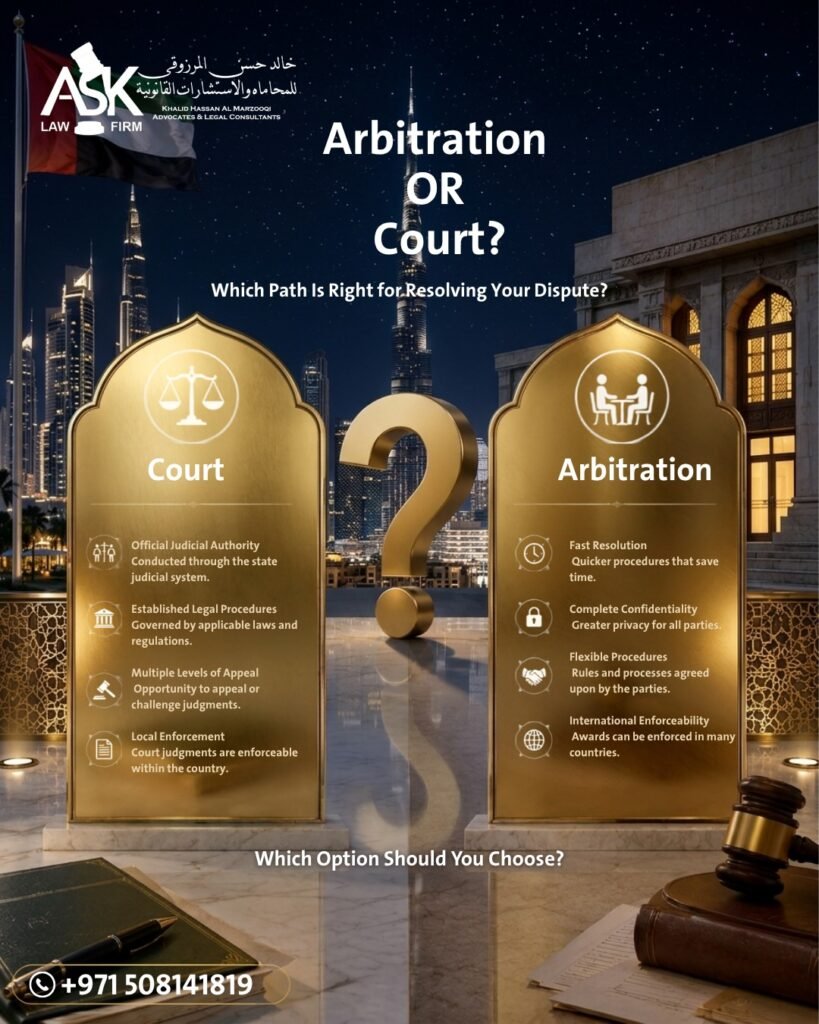
Court judgments are issued according to UAE procedural laws and may, where permitted by law, be subject to appeal through the judicial system.
Key Differences Between Arbitration and Court
Speed
Arbitration generally offers a faster dispute resolution process because the parties can agree on procedural timelines and hearing schedules.
Court litigation follows formal judicial procedures, which may involve multiple stages depending on the case.
Confidentiality
One of arbitration’s strongest advantages is confidentiality.
Sensitive business information, financial records, trade secrets, and contractual documents generally remain private.
Court proceedings are governed by judicial procedures and do not always provide the same level of confidentiality.
Flexibility
Arbitration allows parties to choose:
- Arbitrators
- Language
- Seat of Arbitration
- Procedural Rules
- Hearing Schedule
Court procedures follow mandatory legal rules established by UAE legislation.
Enforcement
Both arbitration awards and court judgments are legally enforceable.
Arbitration awards may also benefit from international enforcement mechanisms in many jurisdictions, making arbitration especially attractive for cross-border commercial disputes.
When Should You Choose Arbitration?
Arbitration is often recommended for:
- International Business Contracts
- Corporate Disputes
- Construction Projects
- Engineering Claims
- Investment Agreements
- Shareholder Disputes
- Commercial Contracts
- Cross-border Transactions
- Technology Agreements
- High-value Commercial Matters
When Should You Choose Court?
Court litigation may be preferable when:
- There is no arbitration agreement.
- The dispute requires judicial supervision.
- The matter falls within areas reserved to the courts under applicable law.
- A party wishes to pursue available judicial remedies and appeal mechanisms where permitted.
Conclusion
Neither arbitration nor court litigation is universally better.
The right choice depends on:
- Nature of the dispute
- Contract terms
- Business objectives
- Time considerations
- Confidentiality requirements
- Enforcement strategy
Professional legal advice before initiating proceedings is essential to protect your rights and maximize the likelihood of a successful outcome.
Contact Us
Khaled Hassan Al Marzooqi Advocates & Legal Consultants
📞 +971508141819
#Arbitration
#CommercialArbitration
#InternationalArbitration
#Litigation
#Court
#Lawyer
#UAELaw
#DubaiLawyer
#SharjahLawyer
#AbuDhabiLawyer
#BusinessLaw
#CommercialLaw
#CorporateLaw
#LegalAdvice
#LawFirm
#BusinessDispute
#ConstructionLaw
#ContractLaw
#InvestmentLaw
#CivilLaw
#CorporateDisputes
#LegalConsultant
#ADR
#DisputeResolution
#ArbitrationLaw
#CommercialLitigation
#UAEBusiness
#LegalServices
#MiddleEastLaw
#BusinessContracts
What is the difference between arbitration and court litigation?
Arbitration is a private dispute resolution process agreed upon by the parties, while court litigation is conducted before the official judicial system.
Is arbitration faster than court proceedings?
In many commercial disputes, arbitration can be faster, although the duration depends on the complexity of each case.
Are arbitration awards legally binding?
Yes. Arbitration awards are generally binding and enforceable after the applicable legal procedures are completed.
Can an arbitration award be challenged?
Only in limited circumstances provided by law.
Is arbitration suitable for all disputes?
No. Certain disputes fall within the exclusive jurisdiction of the courts.
Is arbitration confidential?
Arbitration generally provides a higher level of confidentiality than traditional court proceedings.
Can arbitration awards be enforced internationally?
In many cases, yes, subject to applicable international conventions and local laws.
Do I need a lawyer in arbitration?
Professional legal representation is strongly recommended, especially in commercial and high-value disputes.