
UAE Insolvency Cases Require More Than a Quick Fix: Understanding Financial Restructuring, Preventive Settlement and Bankruptcy
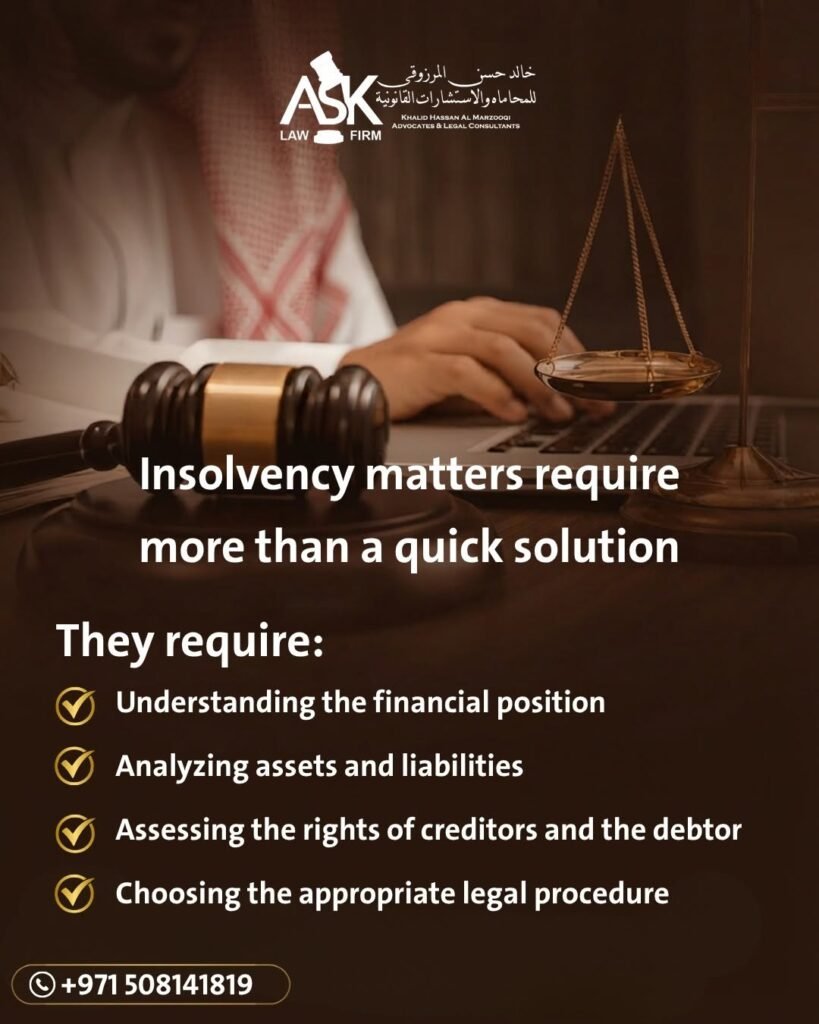
UAE insolvency cases are rarely solved through a single quick legal step. When a company, trader or eligible business debtor begins experiencing serious financial difficulties, the real challenge is to understand the complete financial and legal position, assess the available assets and liabilities, identify the rights of creditors and debtors, and select the appropriate legal procedure before the situation becomes more complicated.
The UAE has developed a modern legal framework for dealing with financial distress through Federal Decree-Law No. 51 of 2023 Promulgating the Financial and Bankruptcy Law, together with its Executive Regulations under Cabinet Resolution No. 94 of 2024. The legislation provides mechanisms designed, among other objectives, to preserve economic activity, protect creditors’ rights, assist debtors in settling their debts and avoid liquidation where possible.
UAE Official Financial and Bankruptcy Legislation
Does financial distress automatically mean bankruptcy?
No.
One of the most important points when discussing bankruptcy in the UAE is that financial distress does not necessarily mean that the business must immediately close down.
The UAE Financial and Bankruptcy Law recognizes mechanisms aimed at helping an eligible debtor continue its business and address its financial obligations where the business remains viable.
The law specifically identifies financial restructuring as procedures intended to assist a debtor in continuing its commercial activity and paying its debts through preventive settlement or restructuring.
Therefore, the first question should not simply be:
“How can we get rid of the debt?”
The better question is:
“What legal and financial procedure can protect the business, maximize the value of its assets and provide the most appropriate outcome for the debtor and creditors?”
Why UAE insolvency matters require a comprehensive assessment
Financial distress can arise from many different circumstances.
A company may face:
- Bank loans.
- Supplier debts.
- Returned cheques.
- Commercial disputes.
- Execution proceedings.
- Rental liabilities.
- Employee obligations.
- Contractual liabilities.
- Declining sales.
- Delayed receivables.
- Personal guarantees.
- Security interests.
- Pledged assets.
- Long-term contracts.
These circumstances cannot always be addressed through ordinary debt collection or informal negotiations.
A proper legal assessment should examine the entire financial structure.
1. Analyse the debtor’s assets
The first stage is to identify all assets.
These may include:
- Real estate.
- Vehicles.
- Machinery.
- Inventory.
- Bank balances.
- Shares.
- Company interests.
- Investments.
- Accounts receivable.
- Intellectual property.
- Deposits.
However, the existence of an asset does not necessarily mean that it can immediately be used to satisfy creditors.
An asset may be pledged, disputed, difficult to liquidate, or essential to the continuation of the business.
Therefore, an insolvency lawyer must look beyond the balance sheet and assess the legal status and practical value of each asset.
2. Analyse all liabilities
The second stage is to identify the complete debt position.
This should include:
- Bank facilities.
- Loans.
- Trade debts.
- Supplier claims.
- Contractor claims.
- Employee-related obligations.
- Rental obligations.
- Government-related liabilities.
- Cheques.
- Court judgments.
- Execution claims.
- Contractual liabilities.
- Guarantees.
The objective is to create a reliable picture of the debtor’s financial position.
3. Classify creditors correctly
Creditor classification is critical.
The UAE Financial and Bankruptcy Law distinguishes between different categories of creditors, including ordinary creditors and creditors whose debts are secured by mortgage, pledge or other legally recognized security or preferential rights.
This distinction can significantly affect the treatment of claims during restructuring or bankruptcy proceedings.
A creditor should therefore not assume that all debts will be treated in exactly the same manner.
Preventive settlement in the UAE
One of the important mechanisms under the UAE Financial and Bankruptcy Law is preventive settlement.
Preventive settlement is designed to help an eligible debtor continue its commercial activity and satisfy its debts through a settlement proposal while allowing the debtor to continue managing its business and assets in the ordinary course, subject to the statutory framework and court supervision.
This mechanism can be particularly relevant where the business remains economically viable but suffers from liquidity pressure or a temporary inability to meet its financial obligations.
A properly prepared settlement proposal may provide a structured framework for dealing with creditors rather than allowing the financial crisis to develop through numerous separate claims and execution proceedings.
Stay of claims and enforcement proceedings
Another significant feature of the restructuring framework is the legal mechanism concerning the stay of claims.
Under the law, a stay of claims may prevent certain lawsuits or execution proceedings relating to the debtor’s assets and debts from continuing during the applicable proceedings, subject to statutory exceptions.
This can be extremely important where a company is facing several creditors simultaneously.
Without a coordinated legal process, individual enforcement actions can potentially undermine the value of the business and make restructuring more difficult.
A structured insolvency process can provide a framework for dealing with creditors collectively and in accordance with the law.
Financial restructuring
Where the business remains viable but requires a deeper financial solution, financial restructuring may become an important option.
The law permits the debtor, creditors and relevant regulatory authority, subject to the statutory conditions, to seek the commencement of restructuring proceedings where the debtor’s business is capable of continuing.
A restructuring analysis may include:
- Cash-flow forecasts.
- Existing liabilities.
- Long-term debt.
- Bank facilities.
- Commercial contracts.
- Assets.
- Business operations.
- Revenue forecasts.
- Creditor claims.
- New financing.
- Repayment plans.
The objective is not simply to postpone debt.
The objective is to create a legally and financially realistic path toward continued business operations and debt settlement.
Can a debtor obtain new financing?
The law provides for the possibility of new financing in the context of preventive settlement proceedings, subject to the applicable legal requirements and approvals.
This can be important where the underlying business remains profitable or potentially viable but is experiencing a temporary liquidity shortage.
In such cases, the problem may not be the absence of a viable business model but rather a mismatch between cash inflows and financial obligations.
A proper restructuring analysis should therefore determine whether additional financing could support the business without unfairly prejudicing creditors.
When can bankruptcy become necessary?
Not every business can be rescued.
Where the debtor has stopped paying its debts, suffers from financial deficiency and the business is no longer capable of continuing, the legal framework provides for bankruptcy proceedings subject to the statutory requirements.
The law identifies conditions relevant to opening bankruptcy proceedings, including cessation of payment, financial deficiency and lack of business viability, together with the other requirements established by the legislation.
In such circumstances, the focus changes from restructuring the business to an organized process for dealing with the debtor’s assets and distributing the proceeds according to the statutory priority framework.
Why waiting can make insolvency more difficult
Financial distress rarely appears overnight.
It often develops gradually:
Delayed payments → supplier pressure → returned cheques → lawsuits → execution proceedings → asset restrictions → declining operations → inability to continue.
Waiting until the final stage can reduce the number of practical options available to the debtor.
It can also increase:
- Legal costs.
- Enforcement pressure.
- Creditor disputes.
- Liquidity problems.
- Business disruption.
- Loss of commercial relationships.
- Difficulty obtaining financing.
- Risk associated with asset disposal.
Certain transactions carried out before bankruptcy proceedings may also become subject to legal review where they are alleged to prejudice creditors and meet the statutory requirements for avoidance.
For this reason, early legal advice is often one of the most important steps in a financial distress situation.
Protecting creditors’ rights
UAE insolvency law is not designed solely to protect debtors.
Protecting creditors’ rights and ensuring fair treatment among creditors are also fundamental objectives of the legislation.
Creditors should therefore carefully assess:
- The legal basis of their claim.
- The amount owed.
- The date on which the debt arose.
- Available guarantees.
- Mortgages and pledges.
- Court judgments.
- Execution proceedings.
- Contractual rights.
- The priority of the claim.
- Applicable filing and voting requirements.
A creditor who fails to monitor an insolvency proceeding may risk missing important procedural steps.
What should a company do when financial distress begins?
A business facing serious financial pressure should consider the following approach.
Step 1: Stop making unstructured decisions
Do not transfer assets, dispose of property or selectively pay creditors without first obtaining proper legal advice.
Step 2: Prepare a complete financial statement
Identify:
Assets + liabilities + cash flow + due debts + expected liabilities.
Step 3: Identify and classify creditors
Determine which creditors are secured, preferential or ordinary, depending on the applicable legal framework.
Step 4: Review contracts
Some contracts may be essential to the continuation of the business, while others may contribute significantly to the financial problem.
Step 5: Determine whether the business is viable
This is one of the most important questions.
Can the business continue if its financial structure is reorganized?
Step 6: Select the legal procedure
Depending on the circumstances, the appropriate route may involve:
- Preventive settlement.
- Restructuring.
- Bankruptcy.
The correct procedure must be selected based on the facts, not simply on the name of the procedure.
The role of an insolvency lawyer in the UAE
A specialist UAE insolvency lawyer does much more than file a court application.
The legal work may include:
- Reviewing financial and legal documents.
- Analysing liabilities.
- Reviewing assets and security interests.
- Assessing litigation and enforcement exposure.
- Reviewing commercial contracts.
- Assessing creditor rights.
- Selecting the appropriate legal procedure.
- Preparing legal submissions.
- Representing the client before the competent court.
- Monitoring creditor claims.
- Assisting with settlement or restructuring proposals.
- Protecting the legal interests of the debtor or creditor.
This is why insolvency matters should not be treated as a simple debt collection problem.
Does the UAE Bankruptcy Law apply to every debt?
No.
The scope of Federal Decree-Law No. 51 of 2023 is legally defined. It applies, among other categories, to companies subject to the Commercial Companies Law, natural persons having trader status, and licensed professional civil companies, subject to the statutory exceptions.
Certain personal, family and consumer debts are treated differently and may fall outside the scope of the commercial bankruptcy framework.
Therefore, the first legal question should always be:
Who is the debtor, and what is the nature of the debt?
What makes a restructuring plan effective?
A successful restructuring plan must be realistic.
It should answer questions such as:
- How will the business continue?
- What revenue is realistically expected?
- What are the operating costs?
- What assets are available?
- How will creditors be paid?
- What is the proposed repayment timeline?
- Is new financing required?
- Which contracts must continue?
- Which contracts should be renegotiated?
- Are there assets that can be monetized?
- Are there pending disputes affecting liquidity?
- What happens if the restructuring plan fails?
A plan based on accurate financial information is more likely to provide a credible foundation for negotiations and legal proceedings.
The importance of early legal advice
The financial crisis does not begin when the bankruptcy application is filed.
It begins much earlier.
A company may experience:
Cash-flow pressure → delayed payments → creditor demands → litigation → enforcement → loss of assets → operational disruption.
Early intervention allows the debtor and its legal advisers to assess the situation while more options may still be available.
This is why professional advice should be sought as soon as significant financial distress becomes apparent.
FAQ – UAE Insolvency and Bankruptcy
Does financial distress automatically mean bankruptcy?
No. Depending on the circumstances, preventive settlement or restructuring may be available where the business remains viable.
What is the difference between restructuring and bankruptcy?
Restructuring aims to assist a viable business in addressing its financial difficulties, while bankruptcy may involve liquidation and distribution of proceeds where the statutory requirements are satisfied.
Can enforcement proceedings be stayed?
A stay of claims may apply following the opening of certain proceedings, subject to the statutory exceptions.
Can creditors apply for restructuring?
Yes. Under the applicable conditions, restructuring proceedings may be initiated by the debtor, creditors or relevant regulatory authority.
Can a debtor obtain new financing?
New financing may be possible under preventive settlement proceedings, subject to the applicable statutory requirements.
Does the UAE Bankruptcy Law cover every type of personal debt?
No. The scope of the law must be examined based on the debtor’s legal status and the nature of the debt.
Can a company avoid bankruptcy?
Where the business remains viable, restructuring or preventive settlement may provide legal options, depending on the circumstances.
When should a company consult an insolvency lawyer?
Ideally, as soon as serious financial distress becomes apparent, before the situation develops into multiple lawsuits and enforcement proceedings.
Conclusion
UAE insolvency cases require more than a quick fix.
They require a structured assessment of the debtor’s financial position, assets, liabilities, creditor rights, contracts, litigation exposure and business viability.
The UAE Financial and Bankruptcy Law provides a legal framework that includes preventive settlement, restructuring and bankruptcy procedures, depending on the circumstances and whether the business remains capable of continuing.
The right legal decision at the right time can make a significant difference between a business that can be reorganized and one that reaches a stage where the available options become much more limited.
If your company is facing financial distress, creditor claims, returned cheques, execution proceedings, bank debts or restructuring challenges, the first step should be a comprehensive legal and financial assessment.
Contact Khaled Hassan Al Marzooqi Advocates & Legal Consultants
📞 Phone: +971 508141819
📧 Email: info@asklegaluae.com
🌐 Website: asklegaluae.com